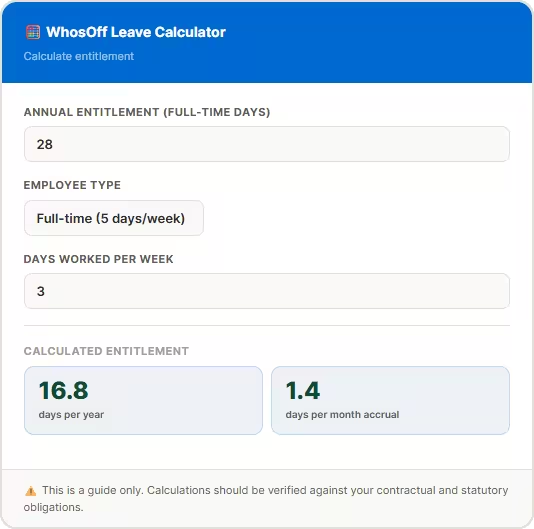


















How to calculate annual leave entitlement - step by step
UK annual leave entitlement varies by working pattern. Here's how to calculate annual leave days correctly for the most common scenarios your HR team will encounter.
Start with the statutory minimum
UK full-time employees are legally entitled to a minimum of 28 days paid annual leave per year under the Working Time Regulations 1998 — including bank holidays. Many employers offer enhanced entitlements above this.
Calculate pro-rata for part-time staff
For part-time employees, divide the number of days they work per week by 5, then multiply by the full-time entitlement. The result should always be rounded up to the nearest half-day, never rounded down.
Adjust for mid-year starters and leavers
For employees who join or leave part-way through the leave year, calculate their monthly accrual rate and multiply by the months worked (or remaining).
Decide how bank holidays apply
Most UK employers include bank holidays within the 28-day statutory minimum. In this case, check which bank holidays fall on the employee's working days - those are deducted from their entitlement. If your company offers 28 days plus bank holidays, the statutory minimum is still met.
🇬🇧 UK Statutory Entitlement
28 daysminimum paid annual leave for full-time UK employees, including bank holidays
5.6 weeksthe same entitlement expressed as weeks - useful for calculating hourly workers' leave
12.07%accrual rate for zero-hours and casual workers, based on hours worked
Source: Working Time Regulations 1998 · Updated 2024
💡 Quick rules to remember
- Always round pro-rata entitlement up - never down
- Part-time staff must receive proportionally the same entitlement as full-time colleagues
- Zero-hours workers accrue leave at 12.07% of hours worked
- Employers can cap holiday pay at the statutory minimum even if enhanced contractual leave is offered
- Leave can be carried over, but only if contractual policy allows - there is no automatic statutory right to carry over unused holiday (with limited exceptions)
- Use the WhosOff free calculator to check any scenario quickly - open the tool
Calculate annual leave days for three common scenarios
These real-world examples show how to calculate annual leave days for the working patterns HR teams encounter most often. Use the WhosOff free calculator to check any variation.
Full-time employee
Sarah works Monday to Friday (5 days/week) and receives the UK statutory minimum entitlement of 28 days, including bank holidays.
Part-time employee (3 days)
Tom works Monday to Wednesday - 3 days per week. His entitlement is calculated pro-rata against the full-time 28-day minimum.
Hourly worker (20 hrs/week)
Aisha works 20 hours/week. Her company offers 28 days (224 hours for full-time 40hr staff). Her entitlement is calculated in hours.
The WhosOff free annual leave calculator handles all working patterns - full-time, part-time, mid-year starters, and hourly workers - in both days and hours. Free to use, no account needed.
Open Calculator 📅 Public Holiday LookupHow to calculate annual leave accrual - monthly rates and the 12.07% rule
Understanding how to calculate leave accrual matters most for new starters, leavers, and zero-hours workers. Here's how holiday leave accrual works in practice, with the formulas you need.
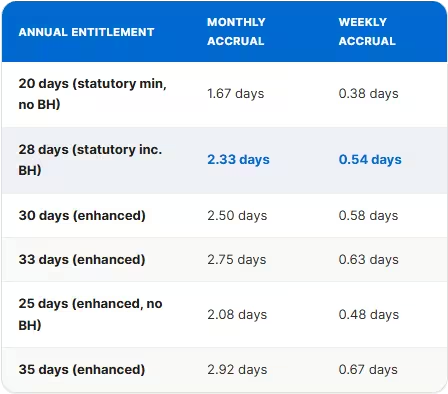
Work out annual leave accrual by month
For most salaried employees, leave accrues at one-twelfth of the annual entitlement per month. This is the standard way to calculate annual leave accrual for mid-year starters and leavers.
12.07% rule for casual and zero-hours workers
Workers with no fixed hours accrue annual leave at a rate of 12.07% of hours worked. This rate is derived from 5.6 weeks' leave as a proportion of the remaining 46.4 working weeks in a year.
Accrued annual leave on termination
When an employee leaves, any accrued annual leave not yet taken must be paid out at the point of termination. Calculate how much leave has accrued in the final part-year using the monthly formula, subtract any leave already taken, and pay the balance.
Once you've calculated leave entitlements, WhosOff helps you manage them all year round
Free annual leave calculator, no sign-up needed
Use the WhosOff free holiday calculator to check entitlements for any working pattern - full-time, part-time, hourly, mid-year. It's a guide to help you get to the right number quickly.
Manage leave requests once entitlements are set
WhosOff is the leave management system that handles everything after you've established entitlements - requests, approvals, shared team calendars, and leave tracking - for teams of all sizes.
Built around UK leave rules
UK bank holiday calendars, Working Time Regulations statutory minimums, and carry-over policies are all built into WhosOff - so the rules you've calculated stay enforced consistently, every year.
UK-based support, Monday to Friday
Our Canterbury-based team answers calls and emails Monday to Friday, 9am–5.30pm. If you have questions about entitlement calculations or how WhosOff handles specific scenarios, they'll have an answer.
WhosOff at a glance
2,500+
companies using WhosOff800k+
employees managed4.4★
average review score20 yrs
in business since 2005- Free annual leave calculator - no sign-up
- Up to 8 weeks FREE trial of WhosOff
- No credit card required
- Public holiday lookup tool also free
- UK bank holidays built in
- Cyber Essentials certified
- G-Cloud Crown Commercial Services supplier
Calculating annual leave manually vs using the WhosOff calculator
You can calculate annual leave by hand - but it's easy to make mistakes, especially with part-time pro-rata and mid-year accrual. Here's what the WhosOff calculator handles for you.
| Scenario | Calculating manually | WhosOff calculator |
| Full-time employee (5 days/week) | Straightforward - 28 days statutory | ✓ Confirms in seconds, no maths needed |
| Part-time pro-rata (any pattern) | ✗ Formula error-prone, easy to round wrong way | ✓ Calculated instantly, always rounds correctly |
| Mid-year starter | ✗ Requires monthly accrual rate + month count | ✓ Enter start date, result calculated immediately |
| Hourly / zero-hours worker | ✗ 12.07% formula, easy to misapply | ✓ Enter hours worked, entitlement calculated in hours |
| Results in days and hours | ✗ Conversion needed, inconsistent across HR team | ✓ Calculate in days or hours - whichever your policy uses |
| Speed | ✗ Minutes per employee, longer for complex cases | ✓ Seconds per employee, any pattern |
Annual leave calculation
questions, answered
Common questions about holiday tracking software and the WhosOff team holiday tracker.
How do you calculate annual leave entitlement in the UK?
Full-time UK employees working 5 days per week are entitled to a minimum of 28 days paid annual leave per year under the Working Time Regulations 1998, including bank holidays. For part-time employees, you calculate pro-rata entitlement using:
For example, an employee working 3 days per week receives (3 ÷ 5) × 28 = 16.8 days. Always round up to the nearest half-day - never round down. Use the WhosOff free annual leave calculator to check quickly for any working pattern.
How do you calculate annual leave accrual for a new starter?
To calculate annual leave accrual for a mid-year starter, divide the full annual entitlement by 12 to find the monthly accrual rate, then multiply by the number of months remaining in the leave year from their start date.
For example, if the leave year runs April to March and an employee joins in October (6 months remaining), with a 28-day entitlement: 28 ÷ 12 × 6 = 14 days.
What is annual leave accrual and when does it apply?
What is the 12.07% holiday leave accrual rate and how do you calculate it?
The 12.07% accrual rate is used to calculate annual leave for workers with no fixed hours - such as zero-hours, casual, or seasonal staff. It represents 5.6 weeks' leave as a proportion of the 46.4 remaining working weeks in a year (52 − 5.6 = 46.4, and 5.6 ÷ 46.4 = 12.07%).
For example: 100 hours worked × 12.07% = 12.07 hours of accrued leave. Note that since April 2024, case law developments have affected how irregular-hours workers' holiday pay should be calculated — always seek up-to-date legal advice for complex cases.
How do you work out annual leave accrual when an employee leaves?
Are bank holidays included in the 28-day UK statutory entitlement?
How do you calculate annual leave for a part-time employee who works different hours each day?
For employees with irregular daily hours, it's usually clearest to calculate leave in hours rather than days - this avoids disputes about whether a "day" means 4 hours or 8 hours. Establish the full-time hourly equivalent (e.g. 5 days × 8 hours = 40 hours/week × 5.6 weeks = 224 hours annual entitlement), then apply the pro-rata fraction based on the employee's contracted weekly hours.
The WhosOff calculator handles hourly calculations directly - select "calculate in hours" when using the tool.
Can annual leave be carried over to the next leave year?
Is the WhosOff annual leave calculator free to use?
What is the difference between annual leave entitlement and accrued annual leave?
Ready to go beyond the calculator?
Join over 2,500 teams that have switched to WhosOff - the staff leave management ool that stays accurate automatically, prevents clashes, and gives every company use of the free annual leave calculator.
Prefer to talk? Call +44 (0)1227 812932 or email our team - Mon-Fri, 9am-5.30pm