As businesses grow, managing employees gets more complex. Tracking annual leave and sickness absence is just one piece of the puzzle - payroll, recruitment, and performance reviews all pile onto the admin plate too.
Eventually, most businesses reach the same fork in the road: do you need a full HR software platform, or is dedicated leave management software enough? The answer depends entirely on what's actually causing you problems.
And it's a question worth taking seriously. UK employees now take an average of 9.4 days' sickness absence a year, and businesses that can't see who's off, when, and why are the ones who feel that pressure hardest. Getting the right system in place isn't just about tidying up admin - it's about keeping the business running.
What's the Difference?
The primary difference is scope.
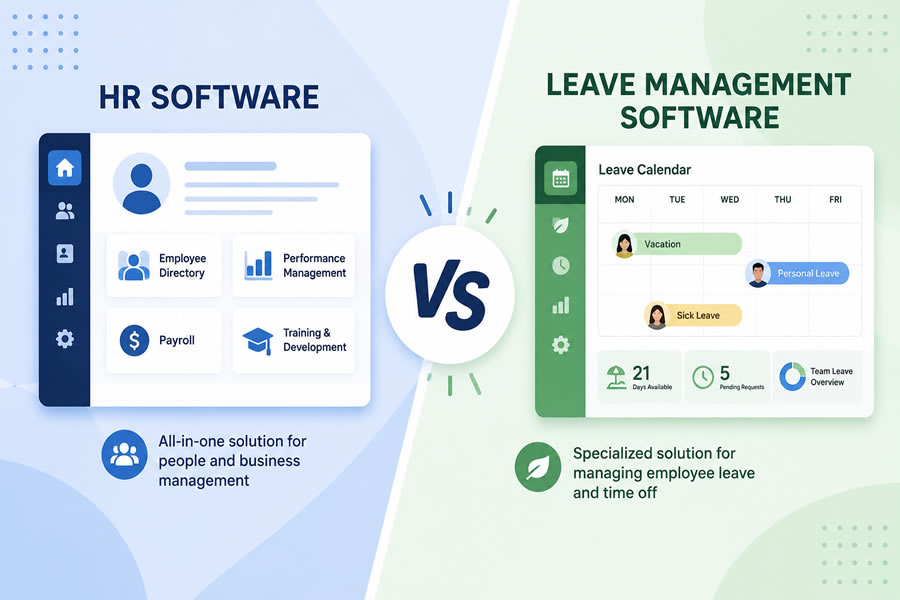
Leave management software focuses on one thing: tracking and approving time off. HR software covers a much wider remit - recruitment, payroll, performance, and training - and typically costs significantly more as a result.
Many HR platforms include leave management features, and some leave management tools integrate with broader HR systems, which can blur the line. But the distinction still matters when you're deciding what to buy.
Leave Management Software
Designed specifically for absence and holiday tracking, leave management software typically covers:
- Holiday requests and approvals
- Absence tracking
- Team calendars
- Leave balances
- Reporting on time off
- Mobile access for employees and managers
This is exactly the territory WhosOff's leave management features live in - built specifically to solve the "who's off and when" problem, without asking you to buy or configure anything else.
HR Software
HR software handles a broader range of processes across the employee lifecycle:
- Recruitment and onboarding
- Employee records
- Payroll integration
- Performance management
- Learning and development
- Document storage
- Leave and absence management
These platforms aim to pull multiple HR processes into one place - which is powerful, but it's also a much bigger investment of time, budget, and change management.
Which Is Better?
Neither is universally better. It comes down to what you actually need.
Leave management software tends to be faster to set up, cheaper, and easier for employees to adopt, because it does one thing and does it well. If leave tracking is your main headache, a full HR suite is probably overkill.
HR software makes more sense if you're managing a large workforce, running a dedicated HR function, or trying to consolidate several separate systems into one. The trade-off is more complexity, longer implementation, and higher cost.
A useful way to frame it: are you trying to fix a specific leave problem, or overhaul how you manage HR as a whole?
When Standalone Leave Software Makes Sense
Many small and mid-sized businesses don't need a full HR suite.
If your main goals are to get rid of spreadsheets, automate leave requests, reduce approval bottlenecks, and give managers a clear view of who is working and when, standalone leave software usually covers all of that at a fraction of the cost.
Setup is faster, training requirements are lower, and employees can get up and running quickly. For businesses where leave is the pain they're actually trying to fix, a dedicated tool often delivers better results than a platform they'll only half-use.
This is where WhosOff has built its reputation over the past 20 years - as a focused, easy-to-adopt alternative to paper forms and shared spreadsheets, used by over 2,500 organisations of every size.
When HR Software Makes Sense
If your organisation is growing fast, or already has a dedicated HR team managing multiple processes, a broader platform may be worth the investment.
Consolidating recruitment, performance, payroll, and leave into a single system has real appeal - fewer logins, shared data, and cleaner reporting. But it comes with a longer implementation timeline and considerably more configuration work upfront, which is worth weighing carefully against the true cost of absenteeism and admin overhead you're actually trying to solve.
Worth noting: sickness absence in the UK is currently at its highest level in more than 15 years, according to CIPD research - a reminder that whichever route you take, absence tracking can't be an afterthought.
A Look Inside WhosOff Key features
If you're leaning towards a dedicated leave management tool, it helps to see what "doing one thing well" actually looks like in practice. Here's a closer look at the core of the WhosOff platform.
Team Calendar & Availability
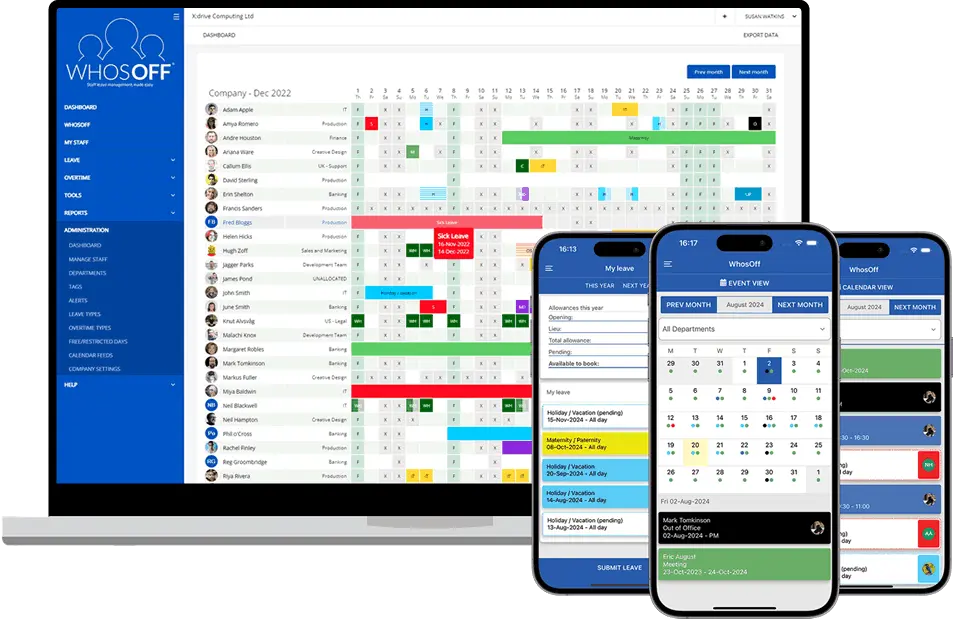
At the centre of WhosOff is a live team calendar that shows exactly who's off, who's working, and who's approaching a clash - at a glance, without digging through emails or spreadsheets.
Staff Hub & Document Storage
Beyond leave, the Staff Hub stores employment contracts, HR policies, and personnel records securely, with read-and-agree receipts for compliance - giving you a slice of "HR software" functionality without the full platform price tag.
Overtime, TOIL & Payroll Reporting
Unlimited overtime types, automatic TOIL tracking, and payroll-ready reports for any date range or department mean your accounts team gets clean data without manual reconciliation.
Integrations That Fit Your Existing Stack
WhosOff connects to the tools teams already use daily - Microsoft Teams, Slack, Google Calendar, Outlook, Zapier, and SSO providers like Okta, OneLogin, and Azure - so leave data flows into your existing workflow instead of sitting in a separate silo.
Online Leave Requests & Approvals
Employees submit holiday requests from the web or the free mobile apps; managers approve or decline in a single click, with instant notifications both ways. It's the same online leave request workflow that replaces the classic "did you get my holiday form?" email chain.
You can see all of this in action with a free trial or a 20-minute personalised demo - no credit card required.
Avoid These Common Mistakes When Choosing
Buying more than you need. Many businesses invest in comprehensive HR systems and end up using a small fraction of the features. Before buying, get specific about the problems you're actually trying to solve.
Prioritising features over usability. A longer feature list doesn't mean better software. If employees don't use it, it doesn't matter what it can theoretically do. Ease of adoption has a bigger impact on outcomes than most buyers expect - a pattern the CIPD's own absence research reflects, noting that most organisations now use some formal process to manage absence, yet many still rely on tools nobody enjoys using.
Ignoring how costs scale. Some platforms look affordable at your current headcount but become expensive as you hire. Check how pricing changes as your team grows - WhosOff's pricing page is transparent about this from day one.
Underestimating setup time. More complex software takes longer to implement. Factor that in, particularly if you're hoping to be up and running quickly.
Which Option Is Right for Your Business?
If your biggest challenge is managing holidays, sickness, and team availability, a dedicated leave management solution is usually the more practical choice. It's cheaper, faster to implement, and easier to get employees using from day one.
If you're looking to digitise multiple HR processes and manage the whole employee lifecycle in one place, a broader HR platform is worth considering - just be honest with yourself about whether you'll actually use everything it offers.
Many organisations find that their biggest HR headache isn't recruitment or performance management. It's simply knowing who is working and who isn't. A dedicated leave management system like WhosOff removes the need for spreadsheets, cuts approval admin, and gives managers instant visibility - without the cost and complexity of a full HR suite.
More on WhosOff
- WhosOff Tour - https://www.whosoff.com/tour
- Pricing - https://www.whosoff.com/pricing
- Integrations - https://www.whosoff.com/features/integrations
- Support & Guides - https://www.whosoff.com/support
- Start a Free Trial - https://www.whosoff.com/sign-up
🚀 Curious how it would work for your team?
Take a self-guided tour, compare WhosOff against other tools like Timetastic or BrightHR, or start your free trial today.
👉 Start your FREE WhosOff Trial Book a 20-min Demo
Frequently Asked Questions
Is leave management software the same as HR software?
Can I use leave management software alongside my existing HR or payroll system?
How long does it take to set up leave management software?
Will a full HR platform be cheaper in the long run?
What size business is leave management software best suited for?


Similar articles
30.SEP.2026
Most businesses don't set out to buy leave management software - they start with a spreadsheet, or a shared Outlook calendar, and it works fine for a while. Then the balances stop adding up, two people get approved for the same week, and nobody's sure which file is actually current. Here's an honest, feature-by-feature comparison of spreadsheets, Outlook calendars, and dedicated leave management software - including exactly where each one starts to fall apart.
22.SEP.2026
Who's in, who's off, and when are they back? It sounds like a simple question - until sickness, holiday clashes, and a spreadsheet nobody's updated since last week make it anything but. Here's a full UK guide to what absence management software actually does, how it differs from leave management, and the rules worth knowing before you build (or fix) your process.
07.SEP.2026
A spreadsheet is fine when there are five of you. It's less fine when requests are arriving by email, WhatsApp, and sticky note, and nobody's quite sure who's actually off next week. Here's a practical look at why leave admin hits small businesses harder than most, and how to know when it's time for something better than a shared spreadsheet.
24.AUG.2026
Leave management looks simple on paper - until three people request the same week off, your busiest month collides with a holiday rush, and someone resigns with ten days still owed. These situations aren't exceptions; they're what HR actually deals with every week. Here's a practical look at the most common leave scenarios, and how the right process (and the right software) stops each one from becoming a headache.