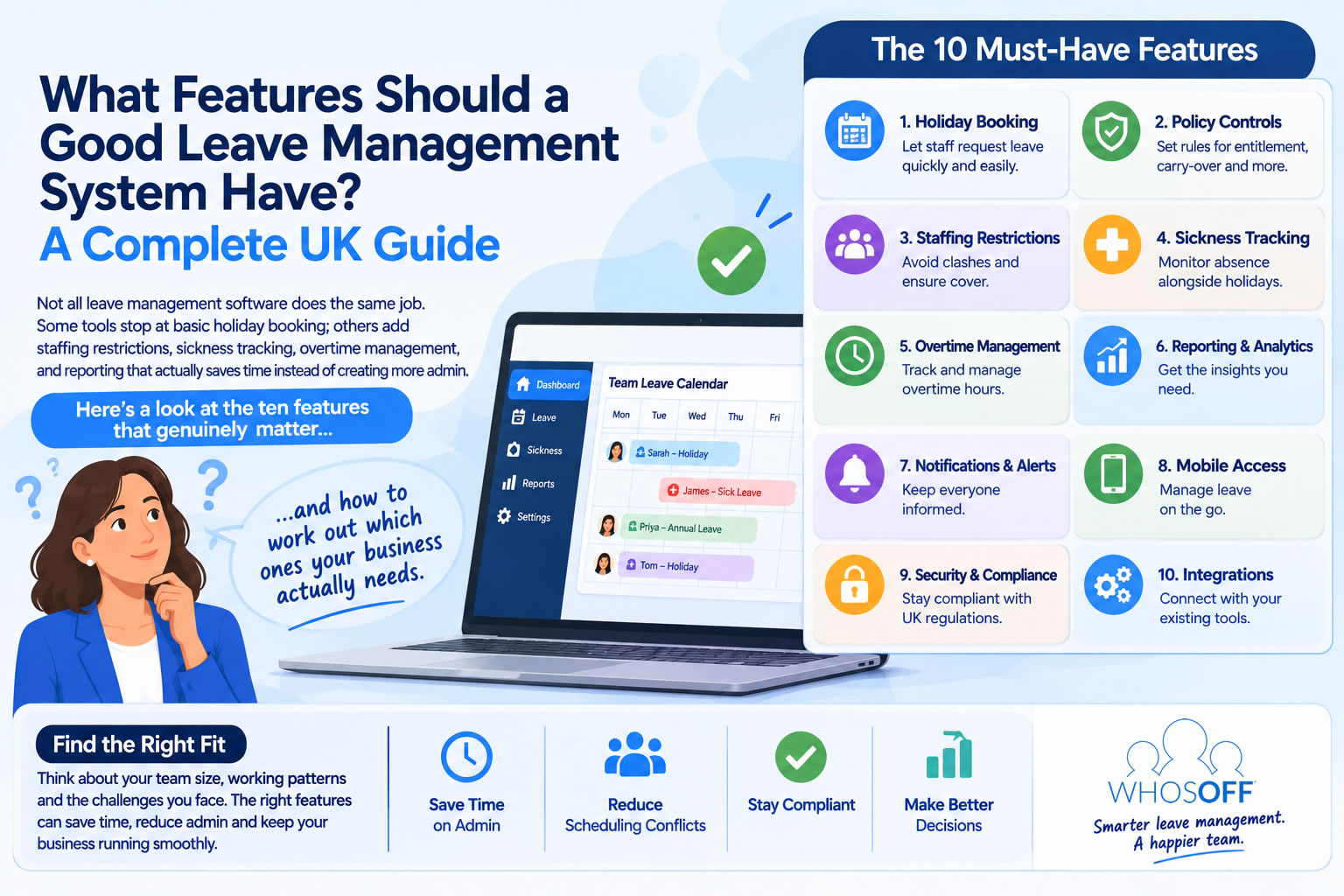
Not all leave management software does the same job. Some tools stop at basic holiday booking; others add staffing restrictions, sickness tracking, overtime management, and reporting that actually saves time instead of creating more admin. Here’s a complete UK guide to the ten features that genuinely matter - and how to work out which ones your business actually needs.
Managing employee holidays should be straightforward. Juggle spreadsheets, email requests and a shared calendar at the same time, though, and even booking a single week off can turn into more admin than it has any right to be.
A good system fixes that for everyone involved: employees request holidays, managers approve them, and HR can see who's off without updating a spreadsheet every time something changes. But leave management systems vary a lot in what they actually offer. Some stick to basic holiday booking. Others add absence reporting, staffing restrictions, overtime tracking and integrations with the tools you already run. The features below are what tends to separate the two, and why each one matters for a UK business specifically.
1. Simple holiday requests and approvals
Booking annual leave shouldn't involve a chain of emails or a paper form. A good system lets employees submit a request online, with the manager getting a notification to approve or decline it. Once it's approved, the allowance and the team calendar should update on their own, without anyone going back to tidy up a spreadsheet afterwards.
Larger organisations should also look for flexible approval workflows, since different departments often have different managers, and some requests need sign-off from more than one person before they're final.
2. Accurate holiday allowance tracking
Calculating annual leave sounds simple until you factor in part-time staff, new starters, odd working patterns and carried-over leave, at which point it stops being simple fairly quickly.
This matters more in the UK than people sometimes expect. Almost all workers are entitled to 5.6 weeks of paid statutory leave a year, which for someone on a standard five-day week usually works out to 28 days (bank holidays can be included in that figure). Different calculations apply depending on working patterns, so a good system needs to handle those variations without relying on a spreadsheet formula nobody wants to touch. Employees should also be able to check their own remaining allowance rather than asking HR every time.
3. A shared staff holiday calendar
Knowing who's off is basic to decent workforce planning. A shared calendar gives everyone, from managers to employees, a clear view of upcoming absences, which matters even more once a business has several departments, remote staff or more than one location.
It's the difference between finding out three key people are on leave before you book an important meeting, rather than after. Or noticing that half a team has already booked the same week off before you approve a sixth request on top of it.
4. Leave restrictions and staffing controls
Seeing who's away isn't always enough on its own. A business also needs enough people actually working to keep things running. A customer service team might need at least four people on shift every day. A retailer might want to restrict leave during its busiest weeks. A manufacturing business might need certain roles covered at all times, no exceptions.
A good system lets managers set restrictions that reflect those requirements directly: capping how many people can be off at once, or blocking bookings on specific dates. Rather than relying on every manager remembering every rule, the policy is enforced by the system itself.
5. Sickness and other absence tracking
Annual leave is only one category of absence. There's also sickness, compassionate leave, unpaid leave, parental leave, medical appointments and time off in lieu, and a good system should record all of it in one place rather than scattering it across separate tabs and inboxes.
That matters for keeping accurate records, and for understanding how absence actually affects the organisation rather than guessing. Sickness reporting is particularly useful here and some systems calculate a Bradford Factor score, which can flag patterns of frequent short-term absence. Those figures are a starting point for a conversation, not a verdict, and should always be read alongside the individual's actual circumstances.
6. Overtime and time off in lieu (TOIL)
For businesses running TOIL, tracking extra hours worked can become its own quiet admin problem. Someone works an extra four hours one week and takes the time back the following month, and without a proper system, that balance starts drifting from reality fairly quickly.
A good platform records overtime, manages TOIL balances and tracks when that time actually gets taken, so both the employee and their manager know exactly what's been earned and what's already been used. It matters most for businesses with flexible working arrangements, or anyone whose staff regularly put in extra hours..
7. Employee self-service and mobile access
How often does someone ask HR how much holiday they've got left, or email their manager to check whether a request actually went through? Each question takes a couple of minutes to answer. Multiplied across a whole organisation over a year, that adds up to a surprising amount of time spent on something employees could answer themselves in seconds.
Self-service removes that friction: staff check their own allowance, submit requests, and see what's coming without needing anyone else involved. Mobile access helps even more for people who don't sit at a desk all day, for example retail, hospitality and manufacturing staff.
8. Reporting and absence insights
Recording who's off is only half the job. A good system should also help a business make sense of that information once it's been gathered.
A manager might want to know how much leave people still have left as the holiday year winds down. HR might need to compare sickness absence across departments. Senior management might want to spot the weeks when staffing consistently runs thin. Without proper reporting, answering any of that usually means stitching together numbers from several spreadsheets by hand. With the right system, the same report takes a few clicks.
9. Integration with existing workplace tools
Bringing in leave management software doesn't mean giving up the tools your business already runs on, a good system should sit alongside them, not replace them.
Integrating approved leave with Outlook or Google Calendar means people can see who's away without switching between applications. Connecting it to Teams or Slack does much the same thing for absence information that would otherwise live in a separate system nobody checks. The point isn't to replace everything you already use. It's to make those tools work better together.
10. Security, usability and support that actually responds
A few practical things matter just as much as the features themselves. Absence information needs handling securely, particularly where sickness records touch on health data, so a good system should limit access so people only see what they're authorised to see.
Ease of use counts for more than it gets credit for. If staff find the software confusing, they'll just go back to emailing their manager directly, and the whole point of the system quietly disappears. And when something does go wrong, you want support that actually answers, ideally during UK working hours.
How do you choose the right system?
Not every business needs every feature on this list. A company with ten employees might just want an easier way to manage annual leave. A larger organisation running several departments is more likely to need detailed reporting, staffing restrictions and layered approval workflows.
Before you commit to anything, ask yourself: are employees constantly asking how much holiday they have left? Are managers tripping over overlapping requests? Is HR spending real time maintaining spreadsheets instead of doing anything else? Do departments run different leave policies from each other? Is sickness, or any other absence type, hard to see clearly right now?
The answers point to which features actually matter for your business. The best system on the market isn't the one with the longest feature list, it's the one that solves the problems you actually have, without dragging in a load of complexity you don't need.
Where WhosOff fits in
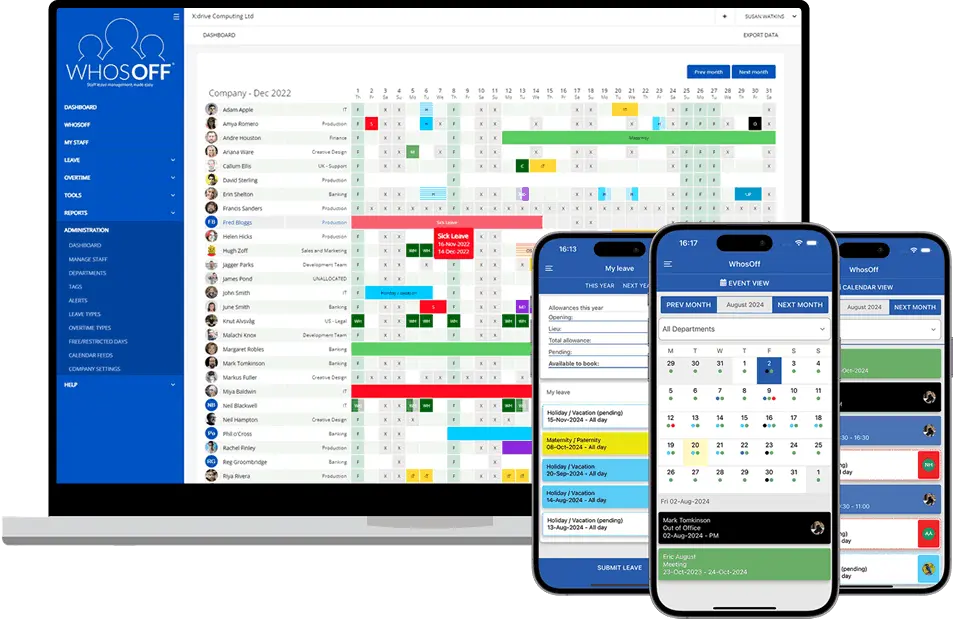
WhosOff brings the features above together in one platform rather than scattering them across separate tools. Employees request annual leave, check their remaining allowance and see the status of a booking without chasing anyone for an answer. Managers review requests against team availability and apply restrictions to keep staffing where it needs to be.
WhosOff also offers sickness tracking, custom leave types, overtime and TOIL, reporting, and calendar integrations, with mobile apps and UK-based support behind it. Rather than running spreadsheets, email and a shared calendar as three separate half-systems, WhosOff pulls the whole process into one place.
🚀 Ready for straightforward leave management?
A leave management system shouldn't create more work than it saves. Done properly, it saves time, cuts down on errors, and gives everyone a clearer picture of who's actually off. Try WhosOff and see what that looks like for your team.
👉 Start your FREE WhosOff Trial Book a 20-min Demo
Frequently asked questions
What features should a good leave management system have?
How much annual leave are UK employees entitled to?
What is a Bradford Factor score, and do I need it in my leave software?
Does leave management software replace tools like Outlook or Teams?
Do small businesses need every feature on this list?
Can leave management software track TOIL and overtime as well as annual leave?


Similar articles
30.SEP.2026
Most businesses don't set out to buy leave management software - they start with a spreadsheet, or a shared Outlook calendar, and it works fine for a while. Then the balances stop adding up, two people get approved for the same week, and nobody's sure which file is actually current. Here's an honest, feature-by-feature comparison of spreadsheets, Outlook calendars, and dedicated leave management software - including exactly where each one starts to fall apart.
22.SEP.2026
Who's in, who's off, and when are they back? It sounds like a simple question - until sickness, holiday clashes, and a spreadsheet nobody's updated since last week make it anything but. Here's a full UK guide to what absence management software actually does, how it differs from leave management, and the rules worth knowing before you build (or fix) your process.
07.SEP.2026
A spreadsheet is fine when there are five of you. It's less fine when requests are arriving by email, WhatsApp, and sticky note, and nobody's quite sure who's actually off next week. Here's a practical look at why leave admin hits small businesses harder than most, and how to know when it's time for something better than a shared spreadsheet.
24.AUG.2026
Leave management looks simple on paper - until three people request the same week off, your busiest month collides with a holiday rush, and someone resigns with ten days still owed. These situations aren't exceptions; they're what HR actually deals with every week. Here's a practical look at the most common leave scenarios, and how the right process (and the right software) stops each one from becoming a headache.